
Alumnus' Commitment Launches New AI-Driven Health Innovation Center
On July 16, Georgia Tech announced the creation of the Parker H. Petit Center for AI-Driven Health Innovation, a new research center that will use artificial intelligence (AI) to help predict, treat, and prevent disease. This has been made possible by a transformational commitment from technology entrepreneur, philanthropist, and Georgia Tech alumnus Parker H. “Pete” Petit, ME 1962, M.S. EM 1964.
Since 1980, Petit has provided significant philanthropic support across campus, including the naming of the Parker H. Petit Institute for Bioengineering and Bioscience (IBB), one of Georgia Tech’s 11 Interdisciplinary Research Institutes. IBB is a hub for transforming biological discovery into real-world health impact, bringing together engineers, scientists, and clinicians to accelerate innovations in diagnostics, therapeutics, medical devices, and biomanufacturing.
 IBB’s success led Petit to make this latest investment, which will build on Georgia Tech’s broader commitment to medical innovation: applying engineering, computing, AI, biosciences, and systems thinking to health challenges that require more than any one field can solve. The Petit Center’s work will strengthen the tools, partnerships, and research pathways needed to help more discoveries move from the lab toward real-world patient care. It will operate under the Institute for Data Engineering and Science (IDEaS) and bring together researchers from across Georgia Tech.
The Petit Center’s first research initiative will focus on creating virtual models of human cells. The initiative will be led by Jeffrey Skolnick, Regents’ Professor and Mary and Maisie Gibson Chair and GRA Eminent Scholar in Computational Systems Biology in the School of Biological Sciences. Researchers will use those virtual models to study how diseases progress and to identify treatments that may work best for individual patients.
“Medical innovation is one of the fastest-growing areas in Georgia Tech’s research, and Pete Petit’s commitment will help us further shape the future of medicine,” said Ángel Cabrera, president of Georgia Tech. “This new research center will find new ways to harness the power of AI to accelerate critical medical discoveries and move them into clinical settings so patients can get the care they need. We’re deeply grateful for Pete’s support, and we’re excited to get started.”
Over time and with additional investments, the Petit Center’s work will expand into areas such as cancer biomarker discovery, healthy aging, advanced cellular therapies, and AI-supported healthcare systems.
“Georgia Tech has the expertise to redefine what is possible in healthcare through AI,” said Skolnick. “By combining advanced computational methods with biological and medical insights, we can create powerful new approaches to predicting disease, identifying treatments, and improving patient outcomes.”
Petit’s commitment will support advanced computing infrastructure, graduate and postdoctoral fellowships, seed research grants, and annual programs that will bring together leading AI and health researchers from around the world.
Petit hopes this investment will inspire others to support interdisciplinary research at the Institute.
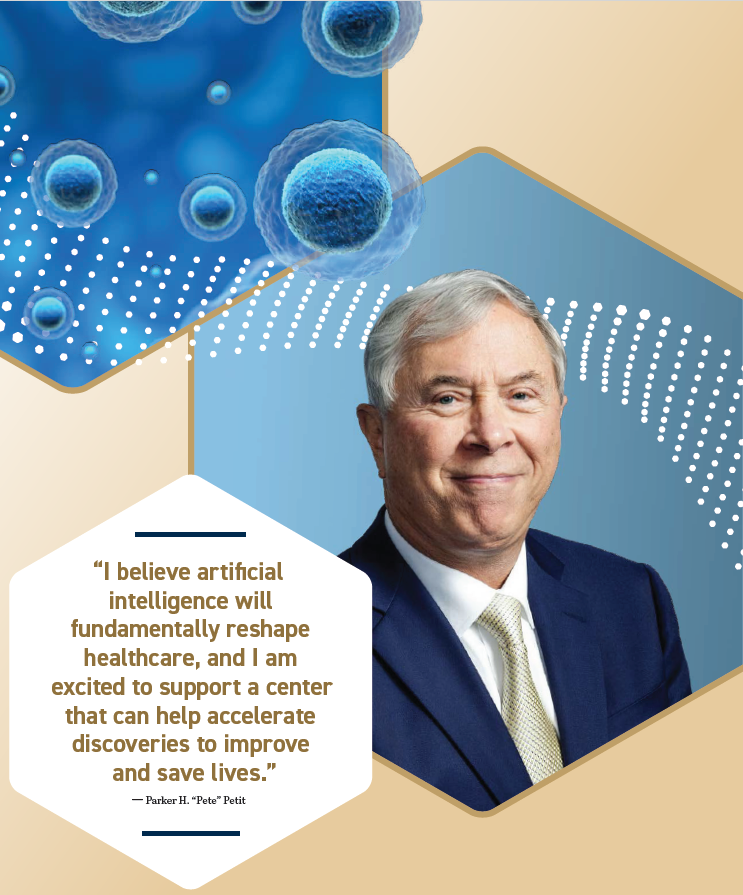
“Georgia Tech has long demonstrated its ability to solve complex challenges,” said Petit. “I believe artificial intelligence will fundamentally reshape healthcare, and I am excited to support a center that can help accelerate discoveries to improve and save lives.”
To support medical innovation and research at Georgia Tech, contact Meg Hendryx, associate vice president for Principal Gifts, at meg.hendryx@dev.gatech.edu.